
Dragon Boat Racing in Indonesia: History and Festivals
2026-10-22 · 5 min read
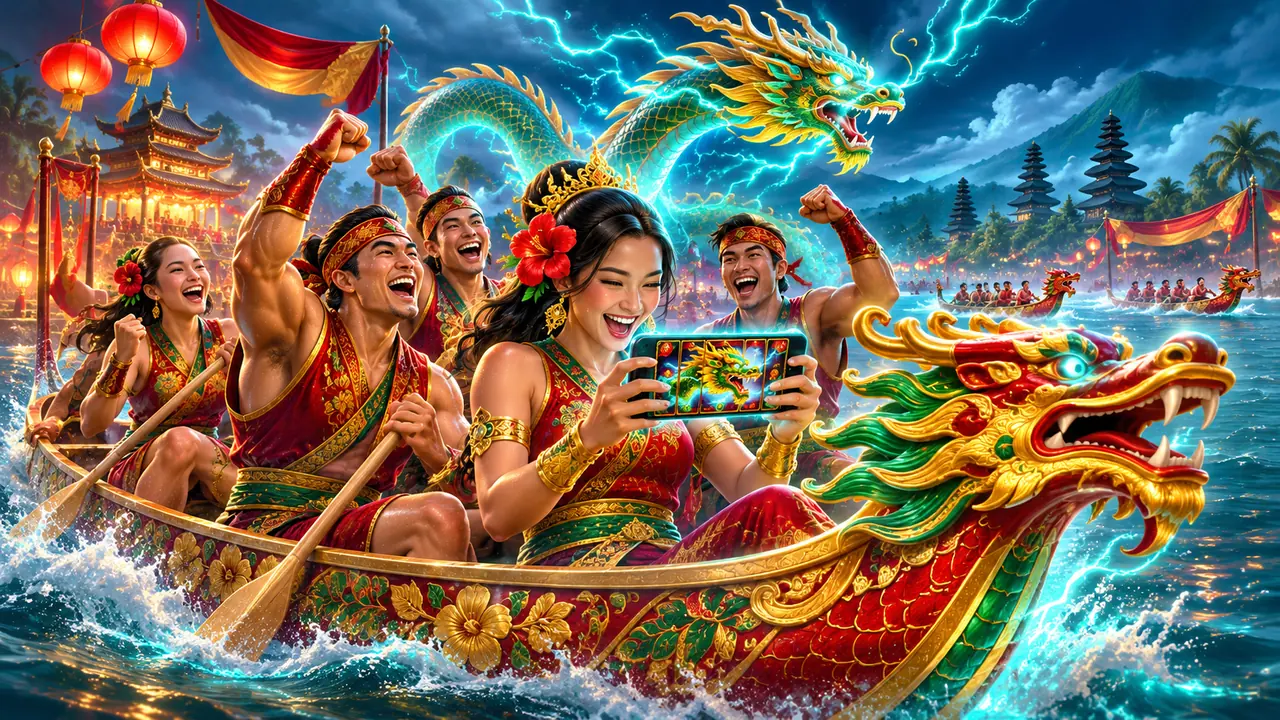
Long before it inspired a slot game, dragon boat racing was a ritual, a festival and a test of teamwork. A long, narrow boat with a carved dragon's head at the bow, a row of paddlers moving as one, a drummer keeping time at the front: the picture is the same whether you stand on a riverbank in southern China, in a Southeast Asian harbour or on the banks of the Cisadane in Tangerang. Here is how it began and how it took root in Indonesia.
An ancient tradition from southern China
Dragon boat racing is usually traced back more than two thousand years to the rivers of southern China. It is closely tied to the Duanwu Festival, held on the fifth day of the fifth month of the Chinese lunar calendar, which normally falls in late May or June.
The best-known story behind the festival is the legend of Qu Yuan, a poet and official of the ancient state of Chu. According to the legend, when he drowned himself in the Miluo River in despair over the fate of his country, local people rowed out to search for him. They beat drums and splashed their paddles to scare fish and evil spirits away, and threw rice into the water so the fish would not touch his body. Those rice offerings are remembered today in zongzi, sticky rice wrapped in bamboo leaves.
Historians point out that boat races on rivers are probably even older than the Qu Yuan story. They may have begun as rituals to honour dragon and water spirits, which were believed to bring rain for the crops.
Peh Cun: the festival in Indonesia
Chinese migrants brought the festival with them to the Indonesian archipelago, and over the generations it became part of local life. In Indonesia it is widely known as Peh Cun, from Hokkien words that refer to rowing boats. The food that goes with it is called bakcang, the Hokkien name for the same bamboo-wrapped rice dumplings.
One of the best-known celebrations takes place in Tangerang, on the Cisadane River. The Chinese-Indonesian community there, often called Cina Benteng, has long held dragon boat races on the river, and the festival has grown into a public event that draws residents of every background to the riverbanks. Similar Peh Cun celebrations are held in other cities with Chinese-Indonesian communities, with their own local flavour.
Some customs are especially loved:
- Balancing an egg. Many families try to stand a raw egg upright at noon on Peh Cun day, a moment that is said to make it easier than on any other day.
- Eating bakcang. Families make or buy rice dumplings filled with meat, mushrooms or sweet fillings, and share them with neighbours.
- Spending the day by the river. Food stalls, music and crowds turn the riverbank into a long, noisy picnic while the boats race.
Public celebrations of Chinese traditions in Indonesia were restricted for several decades during the New Order era. After those restrictions were lifted in 2000, festivals like Peh Cun returned to the public stage, and today they are often celebrated as part of the city's shared culture rather than only by one community.
What happens in a race
A dragon boat crew works like a single body. In a standard boat, around twenty paddlers sit in pairs, side by side. A drummer sits at the front facing the crew, and a steerer stands at the back with a long oar. Smaller boats carry about ten paddlers.
- The drummer sets the stroke rate. Every paddle should enter the water on the beat, and the drummer speeds up for the final push.
- The steerer keeps the boat straight, reads the current and wind, and calls out commands.
- The paddlers need power, but even more they need timing. A crew that is perfectly in sync often beats a stronger crew that is not.
Before a festival race, many communities hold an eye-dotting ceremony, in which the eyes of the carved dragon head are painted to "awaken" the dragon for the race.
From festival to modern sport
Dragon boating is now also a competitive sport with international federations, standard boat sizes and timed races over set distances. It has been part of the Asian Games, including the 2018 edition hosted by Jakarta and Palembang, where the boat races were held on a lake in Palembang. Clubs in Indonesian cities train all year round.
Indonesia also has its own long-boat traditions that are not Chinese in origin, such as Pacu Jalur in Riau, where huge wooden canoes carrying dozens of rowers race on the Kuantan River. In 2025, a video of a young boy dancing at the bow of a Pacu Jalur boat went viral around the world, a reminder of how much joy a boat race can carry. The traditions are different, but the spirit is shared: a whole community gathered by the river to cheer a crew that moves as one.
Why it inspired Naga Dayung
When we designed Naga Petir, we wanted to capture that riverside afternoon: lanterns, drums, the splash of paddles and the roar when two boats finish side by side. That is why our crew has a calm steerer, Kapten Liong, and a drummer, Mei, who sets the rhythm. Our lightning dragon, Si Petir, is pure invention, but we like to think he would fit right in at an eye-dotting ceremony.
If you ever get the chance, go and watch a Peh Cun race in person. Bring an appetite for bakcang, find a spot on the bank and listen for the drums. And if you want a taste of the atmosphere at home, our game guide and about page tell you more about the world of Naga Dayung, a free game played with virtual coins, just for fun.